TAKE ACTION NOW

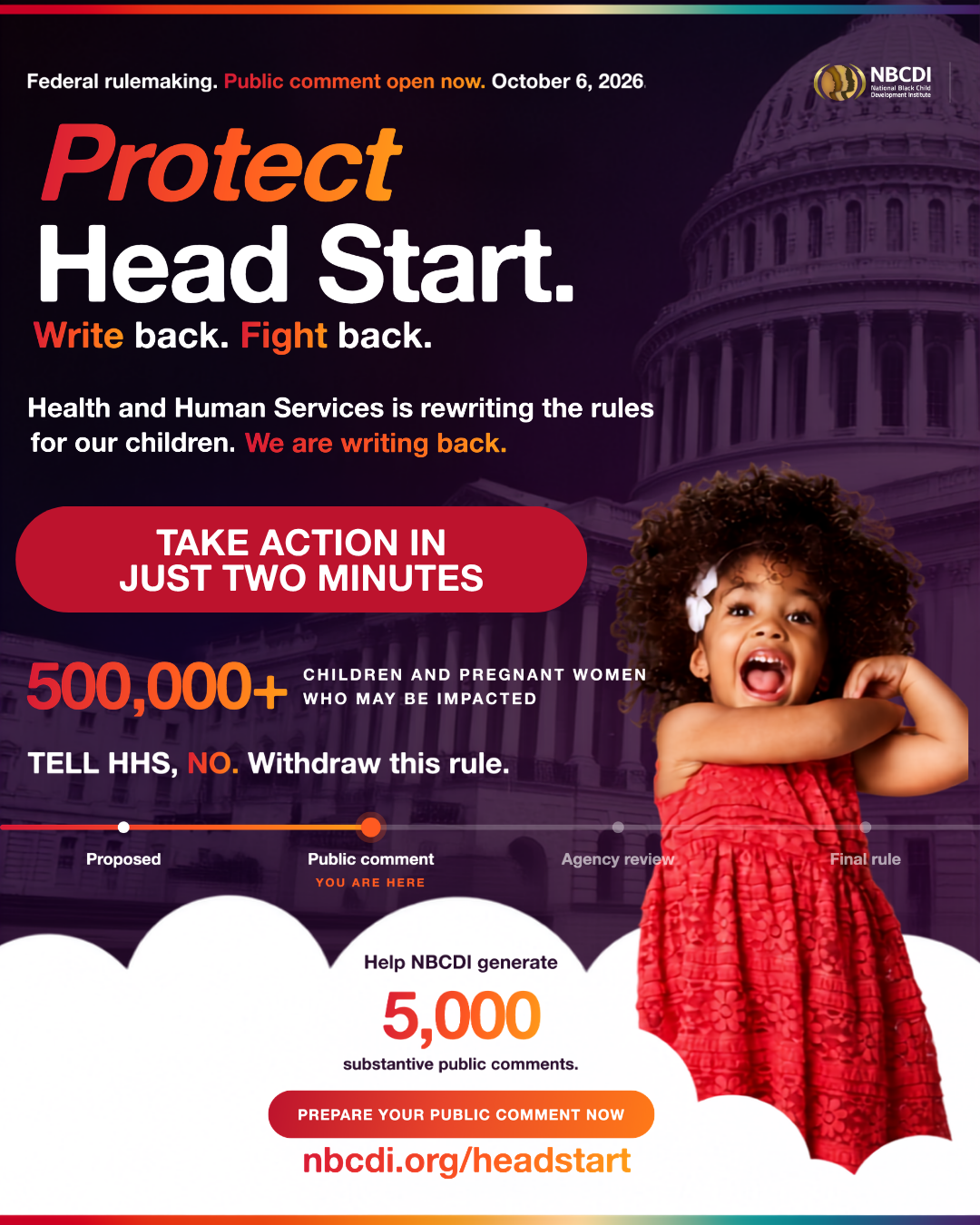
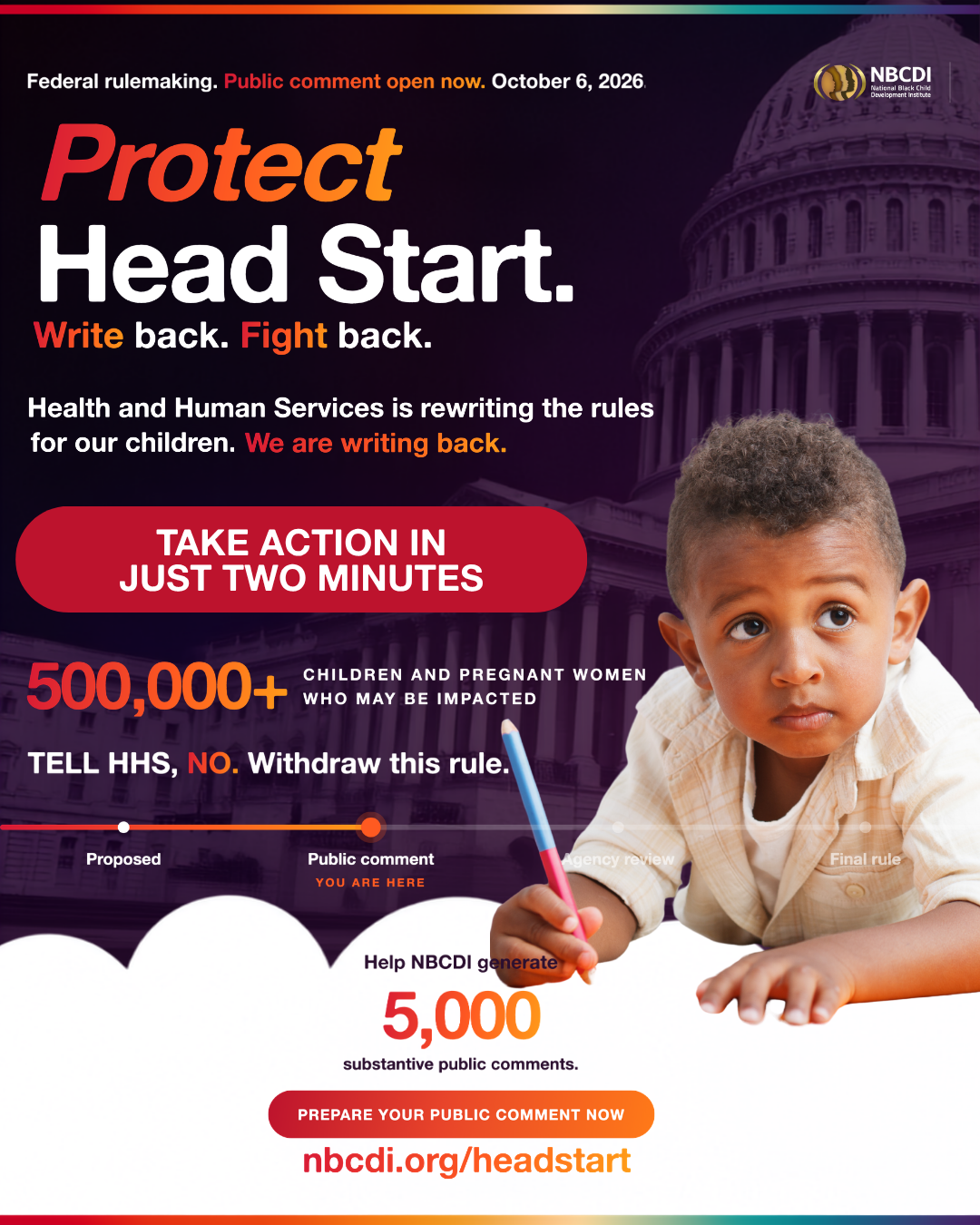
Federal rulemaking. Public comment open now. October 6, 2026.

ProtectHead Start.

Write back. Fight back.

Health and Human Services is rewriting the rules
for our children. We are writing back.

The proposed rule could weaken federal protections that shape class sizes and teacher-to-child ratios, health and developmental supports, disability inclusion, culturally and linguistically responsive learning, discipline protections, and family voice.

500,000+CHILDREN AND PREGNANT WOMEN
WHO MAY BE IMPACTED

TELL HHS, NO. Withdraw this rule.

Families, providers, alumni, experts, advocates and the BCDI Village Network still have power in this record.

Public comment windowAug 7Oct 6
Campaign goal5,000substantive public comments
--days left
--hr
--min
--sec
Proposed
Public comment
You are here
Agency review
Final rule

Prepare your comment now.

Tell HHS, no. Withdraw this rule.

NBCDI has prepared a full draft comment on this page. Begin there, then add your own experience and evidence.

YOU DO NOT HAVE TO WRITE A COMMENT BY YOURSELF.Five minutes. Begin with the draft. Add what Head Start has meant to you, your family, your program, or your community. Then submit it.
1 ยท REVIEW2 ยท PERSONALIZE3 ยท SUBMIT
1
Start with the prepared comment.The policy analysis is already written. Your contribution is the local evidence.
2
Personalize it.Add two to five sentences about your family, your program, your professional expertise, or what a specific protection means locally.
3
Be specific.Name what you want HHS to preserve, what could change for real children and families, and what you recommend instead.
4
Submit your final comment.Submit the form. Your comment files directly to the official federal docket on Regulations.gov.

Organizations, partners + BCDI Villages template

A template is prepared for BCDI Villages and partners. Copy it into the form above, add your organizationโ€™s name, and submit.

COPY THE TEMPLATE

RE: OHS Docket No. ACF-2026-0595, Reducing Federal Burden for Head Start Programs, Black

Child Development Institute of [location] Response to Notice of Public Rulemaking (NPRM)

Dear Secretary Kennedy,

The Black Child Development Institute of [location] represents the diverse strengths and needs of Black

children and families across [location] as a village of the National Black Child Development Institute

(NBCDI). We are proud to be a part of the 56-year legacy of NBCDI to improve the quality of life of Black

children and families.

[INSERT VILLAGE-SPECIFIC PARAGRAPH HERE: relevant BCDI [location] work, state/local Head Start data, and on-the-

ground experience. Remove this instruction before filing.]

Our work is grounded in authentic relationships with families, children, and communities across [city/state].

Through community-based, agency, and philanthropic partnerships we address immediate community

needs via direct services and programs and drive long-term shifts in policy and child and family outcomes

through advocacy and community mobilization. The reach and power of our work provides deep insight to

the lived realities of Black children and families, including the impacts of regulations on access to and

quality of public services and programs within the U.S. Office of Head Start (OHS).

Key Concerns

Head Start serves as a critical foundation for many children and families by providing comprehensive

access to early learning, health and developmental supports, nutritious meals, family engaged decision-

making and well-being services, and stable care environments during the most formative years of life.

Established in 1965, this program was created to ensure that children from families with low incomes have

access to comprehensive services during the earliest years of life, helping to build a strong foundation for

childrenโ€™s early learning and overall well-being. For many Black families, Head Start serves as a critical

source of child care accessibility, support, and stability during the foundational years of child development.

More importantly, Black families disproportionately rely on Head Start programs, with 29% [1] of all

enrolled children being Black, often due to longstanding inequities in access to affordable, high-quality

early childhood education and care, economic equity, and income equality.

The Black Child Development Institute of [location] recognizes the importance of responding to the

Department of Health and Human Services (HHS) Notice of Public Rulemaking on Reducing Federal

Burden for Head Start Programs as it has deep implications on the effective and equitable implementation

of federal early childhood policies connected to our Eight Essential Outcomes for Black Child

Development.

We also deeply understand both the significance of ensuring that Head Start programs have the flexibility

and resources necessary to respond to the children, families, and communities they serve and support

efforts to eliminate duplicative or unnecessary administrative requirements. However, this proposed rule

goes far beyond reducing administrative burden as it would remove many of the quality standards that

define what children and families receive through Head Start and fundamentally alter the federal

government's role in ensuring that children have access to a consistent, high-quality early childhood

experience. The issue before us is therefore not whether Head Start programs should have flexibility, but

instead what protections must remain federal so that flexibility does not become inequity. With this, we

undeniably believe that the proposed changes will dismantle the very foundation on which Head Start

programs stand.

By eliminating the current standards, the embedded safeguards that ensure families are seen as valued

stakeholders and children are safe, supported and receive the comprehensive services necessary for

healthy development and school readiness are at risk. The Black Child Development Institute of [location]

is particularly concerned about the implications for Black children and families, who represent a significant

proportion of children served by Head Start. The proposed rule would remove protections in areas where

many Black children and families already experience significant inequities, including access to health and

developmental services, disability identification and support, exclusionary discipline, culturally responsive

education, family engagement, and equitable access to early childhood opportunities.

Recommendations

We deeply oppose the proposed rule and urge the Administration for Children and Families to:

๏‚ท

Maintain holistic physical and mental health, nutrition, and developmental supports. Head Start should

remain a comprehensive system of support, with continued expectations for health and dental

screenings, developmental referrals, mental health consultation, nutrition, health navigation, and

disability services. Programs should have flexibility in how services are delivered, but not whether

these same services are available to children and families.

๏‚ท

Strengthen protections against exclusionary discipline. Preserve prohibitions on expulsion, corporal

punishment, seclusion, and discriminatory discipline, as well as strict limits on suspension. Programs

should be supported with adequate staffing, mental health consultation, professional development,

and family partnerships to address challenging behavior without inequitably removing children from

Head Start learning settings.

๏‚ท

Safeguard culturally and linguistically responsive learning practices. Maintain expectations that

programs affirm children's racial, cultural, linguistic, and family identities and recognize home

languages as assets. For Black children, this should explicitly include African American/Black culture,

history, family structures, communal customs and language.

๏‚ท

Center community expertise. Implementation should meaningfully engage parents, Black and Brown

family-serving organizations, disability advocacy organizations, early childhood educators, Tribal

communities, and other community-based organizations. By centering the voices and lived

experiences of children, families, educators, and providers most impacted by these proposed

changes, community knowledge should be sourced as essential expertise in determining what

children and families need to thrive in Head Start programs.

๏‚ท

Protecting children with disabilities from program exclusion. Maintain strong standards for disability

inclusion and ensure that disability, behavioral, and/or service needs are never grounds for exclusion.

With this, Head Start programs must have the valuable resources and partnerships needed to support

children in learning settings and collaborate effectively with special needs families.

๏‚ท

Preserving a strong federal Head Start quality standard, which requires the retention of federal

standards for teacher to student ratios, program duration, comprehensive services, developmental

screenings, mental health, disability inclusion, family engagement, recruitment, and culturally

responsive learning supports. Programs may exceed these standards, but federal funding should

never support a lower standard.

As an organization rooted in the rich lived experiences and undeniable brilliance of Black children and

families, the National Black Child Development Institute values Head Start as a vital early child care and

education infrastructure that children benefit from, profoundly shaping their development, learning, health,

and long-term well-being. It is vital that the success of any Head Start changes be measured by whether

children are safer, healthier, supported, affirmed, included, and whether families have meaningful agency.

Furthermore, the proposed changes to Head Start will erode access to early learning for many Black

children and cause detrimental disruptions during the most formative years of their lives.

Copied
What makes a comment substantive?

A substantive comment gives relevant evidence, experience, implementation concerns, consequences, recommendations, or alternatives that the agency can consider in the rulemaking record.

How much do I need to personalize?

Even a few sentences can add useful lived experience or professional expertise. The campaign encourages personalization, but does not present it as a federal legal requirement.

Can an organization submit a comment?

Yes. Use the organizational pathway and only identify an organization if you are authorized to speak on its behalf.

WHAT'S NEXT?

The next step is local. Will you write a letter to the editor?
WRITE A LETTER TO THE EDITOR โ†’

Write a letter to the editor.

A public comment reaches the agency.A letter to the editor reaches the people who live around you, in the paper they already read.

The draft below is yours to use or rewrite. Edit it, sign your own name, and submit it to a publication in your area. Letters are rarely longer than 300 words.

What is a letter to the editor, and why does it work?

A letter to the editor is a written way of talking to a newspaper, magazine, or other regularly printed publication.

It runs on the opinion page, signed by the reader.

Letters are rarely longer than 300 words.

Who does it go to, and how do you send it?

Send it to the opinion or letters editor by email. Publications prefer email.

The address is on the publicationโ€™s opinion page.

Select a category below. Each listing opens an email with the subject line prepared.

Paste the letter into the body of the email. Do not attach it.

Include your full name, your city, a phone number and an email address.

How long should it be, and what happens after you send it?

Rarely longer than 300 words.

Editors trim for length and confirm authorship.

Expect a call or an email before publication.

Submit to more than one publication in your area.

LETTER BUILDER

Edit it, then send it to your outlet.

Send it to an editor

34 named editors, reporters and opinion desks across Black press, local publications and education press. Each listing opens an email with the subject line prepared.

Select a category to begin.

Publications in your own city. Search your cityโ€™s name with the phrase letter to the editor and use the address on that publicationโ€™s opinion page.

If an address is returned undeliverable, send the current one to communications@nbcdi.org.

National Newspaper Publishers AssociationDr. Benjamin F. Chavis, Jr., President and CEOdr.bchavis@nnpa.org
Word In BlackAlvin Buyinza, Education Reportereditor@wordinblack.com
Capital B NewsAlecia Taylor, National Education Reportertips@capitalbnews.org
The RootTatsha Robertson, Executive Editor, Webtrobertson@theroot.com
Trice Edney News WireHazel Trice Edney, Editor in ChiefHazel@TriceEdneyWire.com
Andscape, ESPNCulture deskcontact@andscape.com
Black EnterpriseEditors deskbeeditors@blackenterprise.com
The RootAngela Johnson, Shanelle Genai and Phenix S. Halleyajohnson@theroot.com, phalley@theroot.com, sgenai@theroot.com
URL MediaAnika Palm and the editorial deskanika@url-media.com, garry@url-media.com
EssenceDanielle Wright and Kenyatta Victoriadwright@essence.com, kenyatta.victoria.guwriter@essence.com
Black Iowa NewsDana James, Founder and Publisherdana@blackiowanews.com
The Philadelphia TribuneEditorial desk, Philadelphiabwright@phillytrib.com
The Philadelphia TribuneJohann Calhounjcalhoun@phillytrib.com
The Philadelphia TribuneEdward Gribbin and the newsroomegribbin@phillytrib.com, newsroom@phillytrib.com
Outlier Media, DetroitEditorial deskerin@outliermedia.org
Outlier Media, DetroitNichole Christiannichole@outliermedia.org
Outlier Media, DetroitKoby Levinkoby@outliermedia.org
Outlier Media, DetroitBriana Ricebriana@outliermedia.org
The Tennessee Tribune, NashvilleWriters desktennesseetribunewriters@aol.com
WURD Radio, PhiladelphiaNewsroomInfo@wurdradio.com
The 74Emily Tate Sullivanemily.tatesullivan@the74million.org
The Hechinger ReportJackie Madermader@hechingerreport.org
K-12 DiveKara Arundelkarundel@industrydive.com
ChalkbeatMichael Elsen-Rooneymelsen-rooney@chalkbeat.org
The Hechinger ReportChristina A. Samuelssamuels@hechingerreport.org
ChalkbeatAnn Schimkeaschimke@chalkbeat.org
The 74Amanda Geduldamanda@the74million.org
Education WeekElizabeth Heubeckeheubeck@educationweek.org
Education WeekIleana Najarroinajarro@educationweek.org
ChalkbeatJessie Gรณmezjgomez@chalkbeat.org
The Hechinger ReportOpinion deskopinion@hechingerreport.org
Education WeekOpinion deskOpinion@educationweek.org
Columbia Journalism SchoolSarah Carrsec2002@columbia.edu

Toolkit: Amplify to Protect Head Start.

Help NBCDI generate 5,000 substantive public comments before October 6.

BCDI Villages, partners, teachers, parents, alumni, providers, advocates, and community leaders: use these tools to move people from awareness to action.

POST TO SOCIAL
Protect Head Start social flyer
DOWNLOAD TO AMPLIFY

For Instagram, Facebook, LinkedIn and Threads, in feed and in Stories, and on your organizationโ€™s channels.

AMPLIFY THE ASK

Post it. Collaborate. Add it to your Story.

Every share should move people to nbcdi.org/headstart to prepare a public comment before October 6.

TAG + COLLABORATE WITH NBCDI@nbcdi_
  1. Post the flyer to your feed and your organizationโ€™s social channels.
  2. Collaborate with NBCDI. On Instagram, choose Invite collaborator and add @nbcdi_.
  3. Add it to your Story. Tag @nbcdi_ so NBCDI can reshare it.
  4. Tag the people who can carry it further. Partners, BCDI Villages, teachers, parents, alumni, providers, advocates, and community leaders.
  5. Make the action unmistakable. Include nbcdi.org/headstart and the October 6 deadline.
SOCIAL CAPTION

TAKE ACTION NOW. PROTECT HEAD START.

Time is running out. Your public comment is needed today.

The federal government wants to rewrite the rules for Head Start. 500,000+ children and pregnant women would be impacted.

Tell HHS: no. Withdraw this rule.

Add your public comment: nbcdi.org/headstart

Join @nbcdi_

#ProtectHeadStart #HeadStart #NBCDI #WriteBackFightBack

PUT THE QR CODE ON SCREEN
Protect Head Start presentation graphic with QR code
DOWNLOAD PRESENTATION GRAPHIC
PRESENT + ACTIVATE

One slide, and a room can act before it leaves.

Use the 16:9 graphic in presentations, briefings, trainings, webinars, staff meetings, board meetings, partner convenings, and community gatherings.

  1. Put it on screen as a full slide.
  2. Leave it up long enough to scan.
  3. Say the ask out loud: public comment is open now, and comments close October 6.
  4. Put it in Sunday announcements. Show the slide in worship service announcements every Sunday through October 6, and carry it into bible study, ministry meetings and the church bulletin.
  5. Send people to nbcdi.org/headstart to prepare their public comment.

A sweeping federal rewrite is on the table.

The Administration for Children and Families, within HHS, has proposed a rewrite of the federal rules governing Head Start.

The proposal would remove the detailed national standards that govern the core of a Head Start day, leaving what a child receives dependent on where that child lives. The rule is proposed, not final. The public comment period is open through October 6, 2026.

Government frameReduce administrative burden and increase state and local flexibility.
NBCDI reframeFlexibility should help children. It should not make protection depend on ZIP code.

Read the proposed rule โ†—Official docket โ†—

The decision is not final.Until the window closes, the agency is still building the record it will have to answer for.
Your experience is evidence.Firsthand experience is evidence. What you have observed in a classroom, or lived as a family, belongs in the federal record.
Docket ACF-2026-0595Comments close October 6, 2026.
Leah Austin, Ed.D.
Leah Austin, Ed.D.President and CEO, NBCDI
โ€œHead Start has never been just a program. For generations, it has been part of our nationโ€™s promise that a childโ€™s chance to learn, grow, and thrive should never depend on their familyโ€™s income or background.โ€

These rules shape what children actually experience.

A childโ€™s safety, access, opportunity, and right to belong should never depend on ZIP code, race, disability, family circumstance, or the language that childโ€™s family speaks.

01Safe, high-quality classroomsClass sizes, teacher-to-child ratios, staffing, and quality standards.
02Transportation and safetySafeguards that protect children in the building, on the bus, and on the way home.
03Health and well-beingHealth, mental-health, oral-health, screening, nutrition, and family supports.
04Disability inclusionIdentification, accommodations, individualized support, participation, and accountability.
05Protection from exclusionSuspension, expulsion, discipline, and program exclusion protections.
06Language, culture, and family voiceCulturally and linguistically responsive learning, parent leadership, and program accountability.
Head Start can and should improve. That improvement must strengthen the protections children already have.

Children first.

Especially Black children and families, children with disabilities, dual-language learners, and families who rely on the full range of Head Start services, which this proposal would allow states to reduce.

Head Start Program Facts, FY2024 โ†—

40M+children and families served by Head Start since 1965
500,000+children and pregnant women may be impacted
29%of cumulative enrollment was Black / African American, non-Hispanic or Latino
35%of enrolled children were dual-language learners
15%of cumulative child enrollment were children with disabilities

Preserve the Protections. Build the Future.

NBCDI has never argued that Head Start is finished work. The test is simple: a change that leaves a child less safe, less included, or a family less heard is not an improvement.

Our demandWithdraw this rule. Preserve enforceable national protections, and consult families, providers, Tribal Nations, civil-rights and disability leaders, and early-childhood experts on evidence-based improvements.

Read the record.

Federal Register: Proposed Rule โ†—Reducing Federal Burden for Head Start Programs ยท Federal Register Document 2026-16134
HHS announcement and rationale โ†—HHS frames the proposal around reducing burden, local flexibility, parent engagement, health, and access.
Regulations.gov: Official docket document โ†—Docket ACF-2026-0595 ยท Document ID ACF-2026-0595-0002
Head Start Program Facts: FY2024 โ†—Program scale and demographic data.
NBCDI Eight Essential Outcomes โ†—NBCDI framework for Black child development and well-being.

THE HEAD START OUR CHILDREN DESERVE

The rule is not final.We can still fight it.

Start with the comment. It is the piece that reaches the agency, and the window closes October 6.

SUBMIT MY PUBLIC COMMENT โ†’

Designing the future we imagine

Who is NBCDI?

We are the only national organization focused solely on the unique attributes and needs of Black children, birth through age 8. We exist to fight for the creation of an equitable and just future for Black children and families. We mobilize communities and ignite movements on the strength of Black excellence.